
Physical Cliff?

Near the end of 2012 media coverage, coupled with passionate deliberation concerning a “fiscal cliff” forced public attention, owing to short-term economic impact. January 1, 2013, at 12:01 a.m. the USA went off that fiscal cliff. (I was sleeping and did not hear the noise.) At 2 a.m. the Senate passed a concession with one-vote margin. When before the House passed it midnight that evening there was no such margin —no amendments—by a vote of 257–167. Former President Obama signed next day—a temporary fix running the US into a debt- ceiling crisis for 2013. O was later impeached for imposing bathroom confusion and terror.*
Fiscal Cliff—what a great metaphor with its implication and even evocation of Newtonian laws of gravitation... and also of all the other physical laws, most of which I don’t understand, for example reduction-oxidation and thermodynamics. Although...in my form I feel the decaying flow of entropy—the second law of thermodynamics—increasing almost every moment as I age. My experience understands but not with detailed intellectual insight. This is a physical property in a system decaying in time’s forward flow as I travel through time. Physical, moral, economic—are these laws? Supply and demand?
They say that’s a law.
Of course, you only play with gravity when—well, when the intent is to play. Like those who fall out of planes wearing parachutes, or dive off the mountainside wearing glide suits, arms extended in flight. Some people attach lawnmower engines to ultra-lights and fly, slowing, through the air; mowing low-level clouds.
But lately there’s been some thinking about supply lines. We tend to think of supplies when we hear this
term. ...I’m thinking now about the lines themselves.
Where this is heading? The infrastructure.
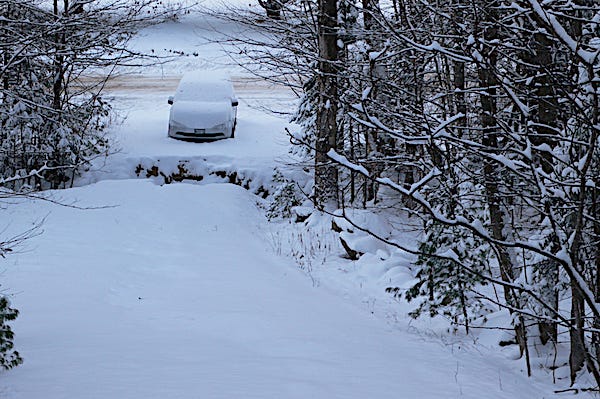
Maybe FEMA
The word being modified as in the word infrared, meaning below red. The electromagnetic frequency just below the color red, and hence located in that part of the spectrum normally invisible to our eyes. We tend not to think of things below sight. Do I see that infrastructure down there supporting me as I shoot down the highway at speeds my primal ancestors would not have believed possible, worthy or wise?
Now, of course, there’s more to this than just the car—which, often, I do, in fact, tend to see. My hands grip the steering wheel firmly. I don’t see the wheels (being so guided), but I do see the line down the middle of the road, except when it’s icy. Then I may notice the giant state snowplow coming toward me in the middle-of-the-road with its great load of sand/salt being laid down behind. Ah, the gas pedal eases as I lift my foot.
It’s working! Hooray! But, NO—I don’t really think about the laws. I may or may not notice my hands on the wheel, but I certainly did not see all those hands making my car, the snowplow, and this roadway—including the robots made by other robots made by still other robots made by human hands. (If we’re lucky, some human hands are in there somewhere.)
If these hands are attached to one who is in the habit of praying there comes a firm connection in mind between them and the moral laws. Stewardship. Something along the lines of, “Make and maintain as well as you can. Lives may be depending on this.”
That salt truck is grand! A huge gas-guzzler but worth keeping the roads safe in winter. A part of the infrastructure I don’t mind paying for. With taxes.
It wasn’t that long ago on this very road—not the same surface, not the same width, not with good ditching—that my neighbors’ ancestors whooshed along in horse- and-sleigh. I won’t talk about how that sleigh got put together, or that horse, but about the roadway itself. Those ancestors made this road themselves. Without taxes. Each household along the supply line did the work required to make their part as good as possible with hands shovels twitch-horses crosscut saws, rollers (to tamp the snow in winter)....
Perhaps they made it fun with work parties ... joining all these links of road in order to make something good enough to get them to the county seat or the railway ... when that bit of infrastructure came into being. This way they weren’t complete subsistence farmers but could do a little marketing as well.
Really, I like to pay taxes for this work. This gives our neighbors, well, work. Taxes help keep stewards out of trouble. Think. They’ve been elected solely to keep things in order, working true, law-abiding—physically law-abiding pipelines to take away sewage through towns. When these pipes start to break they’ve got to be repaired or we get inundated with sewage.
Taxes—good stewards know—are not meant to subsidize large offshore corporations. Taxes are meant to keep physical things working so that things supplied have lines to travel on, reaching their destinations. Even things made offshore. Money is meant not to be money but to be jobs, to be maintaining, to be food and clothing, and solid supply lines.
Like our ancestors, of whom I still can’t believe they lived as they did, we’ve got to subsist. But unlike them we don’t know how to do it without our (now decaying) infrastructure. Simply think of the categories of things we need to keep going, including especially education, and make a list. Be a good steward.
That oil running everything? Kinda fragile, tenuous dependence there. Better pray.
I am in awe of the infrastructure. It’s almost a god to me. How can something so prone to (and in the continual process of) decay be worshipful (you may sensibly ask)? Something so fragile and helpless and in need of constant repair?
Actually; the infrastructure is like a god in that it destroys itself through physical laws and is constantly rebuilt through those same laws. Elements melt with fervent heat. Things made of them also fall apart into their corollary constituents through rust and decay. Go god go! Go infrastructure go!
Even the Old Testament God needed help. Remember the story of Aaron upholding Moses’s arms? If Moses’s arms fell, the enemies prevailed. If they stayed up Joshua’s troops prevailed. YHWH, or “he who creates,” or “he causes to be,” YHWH himself was supported by the act of faith.
Quoting scripture: “Underneath are the everlasting infrastructures.”
Hmm.
“Underneath are the everlasting electric grids, sewer pipes?”
“Roads and bridges?” “Tunnels”?
Evidently this essay needs work. Taxes won’t help, though. Save them for the important stuff. Save them for the god.
This is my body, breaking for you. Get busy. Stop shuffling those zeros and ones ... or it will be gone.
*Joke?
© S. Dorman January 2024